The Hidden Cost of Chargebacks Most Ecommerce Brands Never Calculate
The true cost of a chargeback is 2–5x the order value once you factor in CAC, inventory, shipping, fulfillment, labor, processor penalties, and lost LTV. Here's the full breakdown.
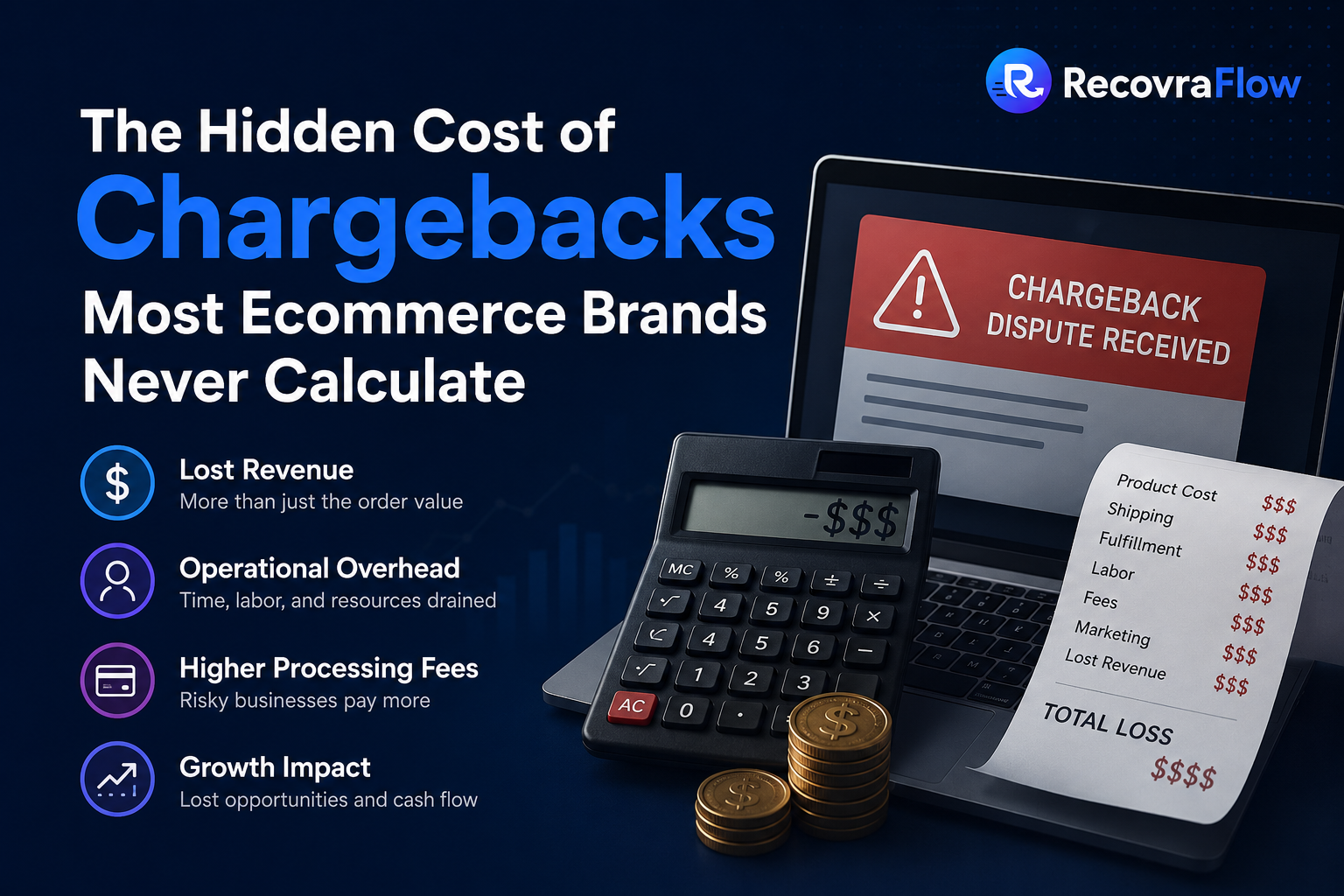
In the ecommerce world, chargebacks are often treated as an unavoidable cost of doing business. A customer disputes a transaction, funds are withdrawn from the merchant's account, a chargeback fee is assessed, and the business either fights the dispute or accepts the loss. Most ecommerce brands look at the order value, add the chargeback fee, and move on.
Unfortunately, that approach dramatically underestimates the true financial damage chargebacks create.
The reality is that the vast majority of ecommerce businesses are calculating chargeback losses incorrectly. While the disputed transaction amount is certainly part of the equation, it represents only a fraction of the actual cost. Hidden expenses ripple throughout nearly every area of the business — operations, customer service, marketing, fulfillment, cash flow, payment processing, fraud prevention, and long-term profitability.
For many online stores, the true cost of a chargeback can be two, three, or even five times higher than the original order amount. Over the course of a year, these hidden losses can quietly drain tens of thousands or even hundreds of thousands of dollars from a business without owners fully realizing where the money is going.
What is a chargeback?
A chargeback occurs when a customer disputes a credit card transaction directly with their bank or card issuer instead of contacting the merchant for a refund. The bank temporarily reverses the payment while investigating, and the merchant must provide evidence proving the transaction was legitimate.
Chargebacks were originally introduced as a consumer protection mechanism — designed to help cardholders recover funds in cases of fraud, stolen cards, unauthorized transactions, or undelivered goods. Today, they can result from:
- Unauthorized transactions
- Stolen payment information
- Friendly fraud
- Product not received claims
- Product not as described claims
- Subscription billing confusion
- Shipping delays
- Duplicate transactions
- Merchant processing errors
- Customer misunderstandings
Why most ecommerce brands calculate chargeback costs incorrectly
Ask most store owners how much a chargeback costs and you'll hear something like: order value $100 plus a $25 chargeback fee equals $125. Technically correct from an accounting perspective — and completely wrong in practice.
The transaction amount is only the beginning. What about the product itself, the advertising used to acquire the customer, shipping, fulfillment, employee labor, lost customer lifetime value, payment processor penalties, fraud prevention costs, and cash flow restrictions? These expenses remain invisible because they are spread across multiple departments rather than appearing in a single chargeback report.
The hidden cost of customer acquisition
One of the largest overlooked chargeback expenses is customer acquisition cost (CAC). Before a customer ever reaches checkout, your business has already invested in Google Ads, Facebook Ads, TikTok, influencers, affiliates, SEO, content, email, and retargeting.
Many brands now spend $20 to over $100 to acquire a single customer. Imagine spending $50 in advertising to acquire a customer who places a $120 order. If that customer files a chargeback, the business loses not only the sale but the entire marketing investment used to generate it. For brands spending heavily on paid acquisition, CAC may be the single largest hidden chargeback expense.
Inventory losses extend beyond lost revenue
When customers request standard refunds, merchants often recover inventory through product returns. Chargebacks work differently — in many cases, the customer keeps the product while simultaneously receiving their money back.
The merchant loses the product, the sale, and the margin. The true inventory cost includes manufacturing, wholesale cost, import duties, freight, storage, and inventory carrying cost. A merchant selling a $150 product may see a $150 chargeback but absorb an additional $50 to $80 in inventory loss. Over hundreds of disputes, this becomes a major profit drain.
Shipping costs continue rising
Most merchants pay shipping regardless of whether a chargeback occurs. Carriers do not refund shipping fees, fuel surcharges, insurance, delivery confirmation, or signature confirmation when a customer disputes a charge. The package has been delivered, the cost has been incurred, the merchant bears the loss.
Fulfillment expenses are frequently ignored
Every order requires picking, packing, QC, labeling, warehouse labor, inventory management, and storage. Once an order ships, those costs become permanent regardless of any later dispute. For high-volume operations, fulfillment-related losses represent thousands of dollars annually.
Administrative labor costs add up quickly
Chargebacks consume time. Every dispute requires reviewing order records, collecting transaction details, locating customer communications, retrieving shipping documentation, drafting responses, submitting documentation, and monitoring outcomes.
A simple dispute may consume 30 minutes to an hour. Complex disputes can require several hours of investigation. Multiply by dozens or hundreds of disputes per month and labor costs become substantial — yet most businesses never formally track this time.
Friendly fraud is growing every year
Friendly fraud occurs when customers dispute legitimate transactions despite receiving the products or services they purchased. It's now estimated to account for 70%+ of ecommerce chargebacks, driven by how frictionless mobile banking has made the dispute flow. Cardholders increasingly view chargebacks as a faster alternative to contacting customer support.
Lost customer lifetime value creates long-term damage
A customer who spends $100 today may spend $300 next year and over $1,000 across several years — plus referrals. When disputes occur, merchants often lose the opportunity to build that long-term relationship. The future revenue lost from a single customer can far exceed the value of the disputed transaction.
Increased fraud prevention expenses
As chargeback rates rise, businesses invest more heavily in fraud detection software, identity verification, device fingerprinting, risk scoring, transaction monitoring, fraud analysts, and security consultants. Necessary — but another indirect cost driven by dispute volume.
Higher payment processing fees
Payment processors closely monitor chargeback activity. Merchants with elevated dispute rates are viewed as higher-risk and may face increased transaction fees, required reserves, stricter underwriting, limited processing capabilities, and account reviews. Even small fee increases create major financial consequences at scale.
Reserve requirements restrict growth
Excessive chargebacks can trigger a rolling reserve, where the processor withholds 5%, 10%, or even 15% of future revenue to cover potential disputes. The money is technically yours but inaccessible — creating cash flow constraints that affect inventory purchases, ad spend, hiring, and expansion.
Chargeback monitoring programs can become extremely expensive
Visa and Mastercard actively monitor merchant dispute activity. Merchants that exceed acceptable thresholds get enrolled in monitoring programs with monthly fines, compliance requirements, mandatory remediation plans, and escalating processor scrutiny. Repeated violations can jeopardize a merchant's ability to process card payments at all.
Chargebacks distort business analytics
Chargebacks degrade the accuracy of revenue reporting, CAC, ROAS, LTV, conversion rates, and profitability analysis. When revenue is later reversed, executives may believe campaigns are more profitable than they are. Marketing budgets get misallocated. Growth forecasts become unreliable. These indirect costs influence strategic decisions for months or years.
Team morale and productivity suffer
Customer service, operations, finance, and leadership all spend increasing time on disputes. Over time, constant dispute management lowers productivity and morale across the organization.
Why ecommerce brands must take chargebacks seriously
Chargebacks are not isolated incidents — they are a systemic threat to profitability that affects revenue, inventory, cash flow, customer relationships, marketing efficiency, operational costs, payment processing health, and long-term growth. Brands that actively manage disputes gain a significant advantage over competitors who simply absorb losses.
How RecovraFlow helps ecommerce businesses recover revenue
RecovraFlow was built to help ecommerce brands fight back against chargeback losses through intelligent automation and evidence-based dispute management. Instead of manually gathering records and building dispute responses, RecovraFlow helps merchants:
- Detect chargebacks immediately via processor webhooks
- Collect evidence automatically from your store and shipping carriers
- Organize transaction, AVS/CVV, and device data
- Generate professional, reason-code-specific dispute responses
- Reduce administrative workload by 90%+
- Improve recovery rates from ~25% industry average to 60–75%
- Scale chargeback operations without scaling headcount
The bottom line
Most ecommerce businesses dramatically underestimate the true cost of chargebacks. The disputed transaction amount and chargeback fee represent only a small portion of the financial damage. When CAC, inventory, shipping, fulfillment, labor, fraud prevention, processor penalties, reserves, lost LTV, distorted analytics, and restricted cash flow are fully considered, a chargeback can cost several times more than the original order value.
For growing ecommerce brands, understanding these hidden costs is critical to maintaining healthy margins and sustainable growth. RecovraFlow automates dispute detection, evidence collection, and response generation so merchants can recover revenue that would otherwise be lost — protecting cash flow and freeing teams to focus on scaling with confidence.